Red Flags in Pediatric Head Trauma: A Multicenter Analysis of Predictors of Intracranial Injury
DOI:
https://doi.org/10.46900/apn.v8i3.391Keywords:
Brain injuries, Pediatric Traumatic Brain Injury, risk factors, TomographyAbstract
Background: Pediatric traumatic brain injury (TBI) is a leading cause of childhood mortality. The early identification of variables that predict adverse outcomes may help refine clinical decisions. This study aimed to determine the variables associated with poor outcomes in pediatric TBI.
Methods: A retrospective multicenter study was conducted in pediatric patients with TBI admitted at a public and a private reference center in Minas Gerais, Brazil. Nineteen demographic and clinical variables were assessed as predictors of intracranial hemorrhage, skull fracture, neurosurgical intervention, and mortality using multivariable logistic regression.
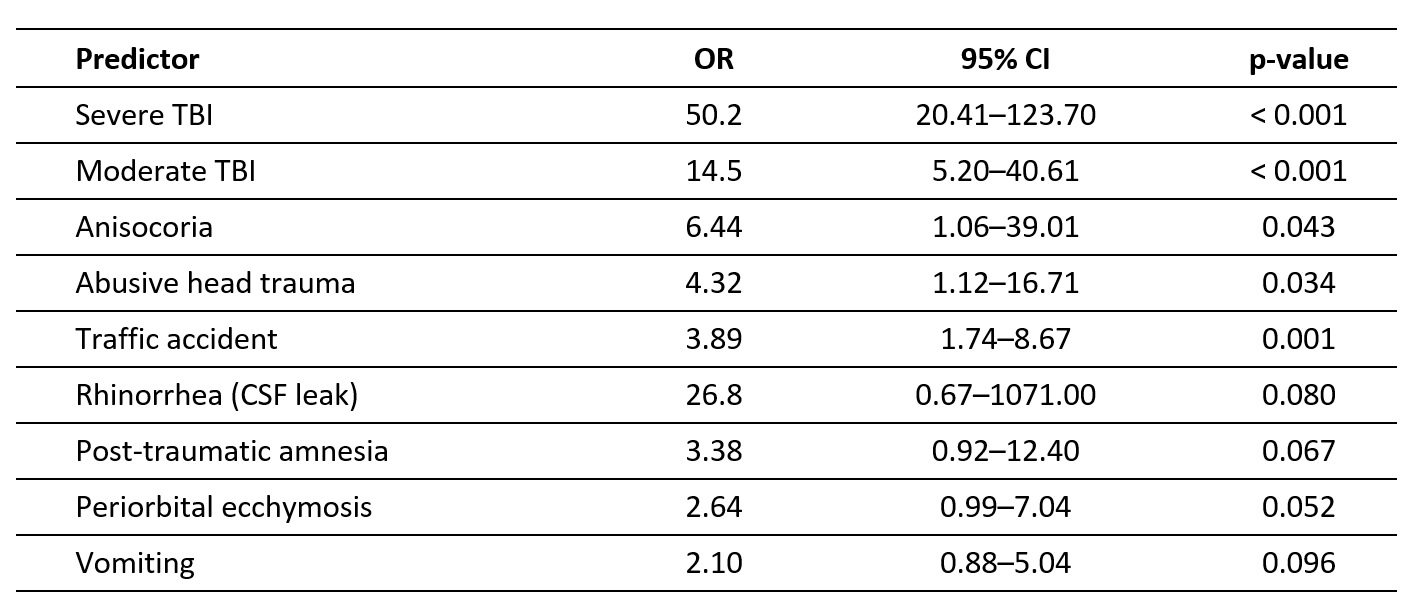
Results: A total of 3,049 patients were evaluated (58.9% male) from 2019 to 2020. The mean age was 5.6 years (SD 5.3; median 3.6). Falls were the most frequent mechanism of trauma (84%), and a cranial tomography was performed in 37.4% of cases. Intracranial hemorrhage was associated with severe TBI (OR 63), periorbital ecchymosis (OR 7.07), and traffic-accident (OR 5.05). Skull fracture was associated with retromastoid ecchymosis (OR 22.8), severe TBI (OR 16.3), and post-traumatic seizure (OR 9.05). Severe TBI (OR 50.2), anisocoria (OR 6.44), and abusive head trauma (OR 4.32) were related to neurosurgical intervention.
Conclusions: This large multicenter study reinforces the importance of TBI severity, as assessed by the Glasgow Coma Scale, as well as the role of abusive head trauma as a predictor of poor outcomes. The development of novel algorithms should be encouraged to improve care for pediatric trauma.
Downloads
Downloads
Published
How to Cite
Issue
Section
Categories
License
Copyright (c) 2026 Leopoldo Mandic, José Aloysio, Eduardo Schuch, Isabella Riccielli , Maria Letícia , Marcio Junior, Antonio L Teixeira, Aline silva

This work is licensed under a Creative Commons Attribution 4.0 International License.

When publishing in Archives of Pediatric Neurosurgery journal, authors retain the copyright of their article and agree to license their work using a Creative Commons Attribution 4.0 International Public License (CC BY 4.0), thereby accepting the terms and conditions of this license (https://creativecommons.org/licenses/by/4.0/legalcode).
The CC BY 4.0 license terms applies to both readers and the publisher and allows them to: share (copy and redistribute in any medium or format) and adapt (remix, transform, and build upon) the article for any purpose, even commercially, provided that appropriate credit is given to the authors and the journal in which the article was published.
Authors grant Archives of Pediatric Neurosurgery the right to first publish the article and identify itself as the original publisher. Under the terms of the CC BY 4.0 license, authors allow the journal to distribute the article in third party databases, as long as its original authors and citation details are identified.