Decompressive craniectomy in children and adolescents with severe traumatic brain injury: a systematic review.
Decompressive craniectomy in children with severe TBI.
DOI:
https://doi.org/10.46900/apn.v8i3.370Keywords:
decompressive craniectomy, children, Traumatic brain injury, Infant Mortality, Prognosis, neurosurgeryAbstract
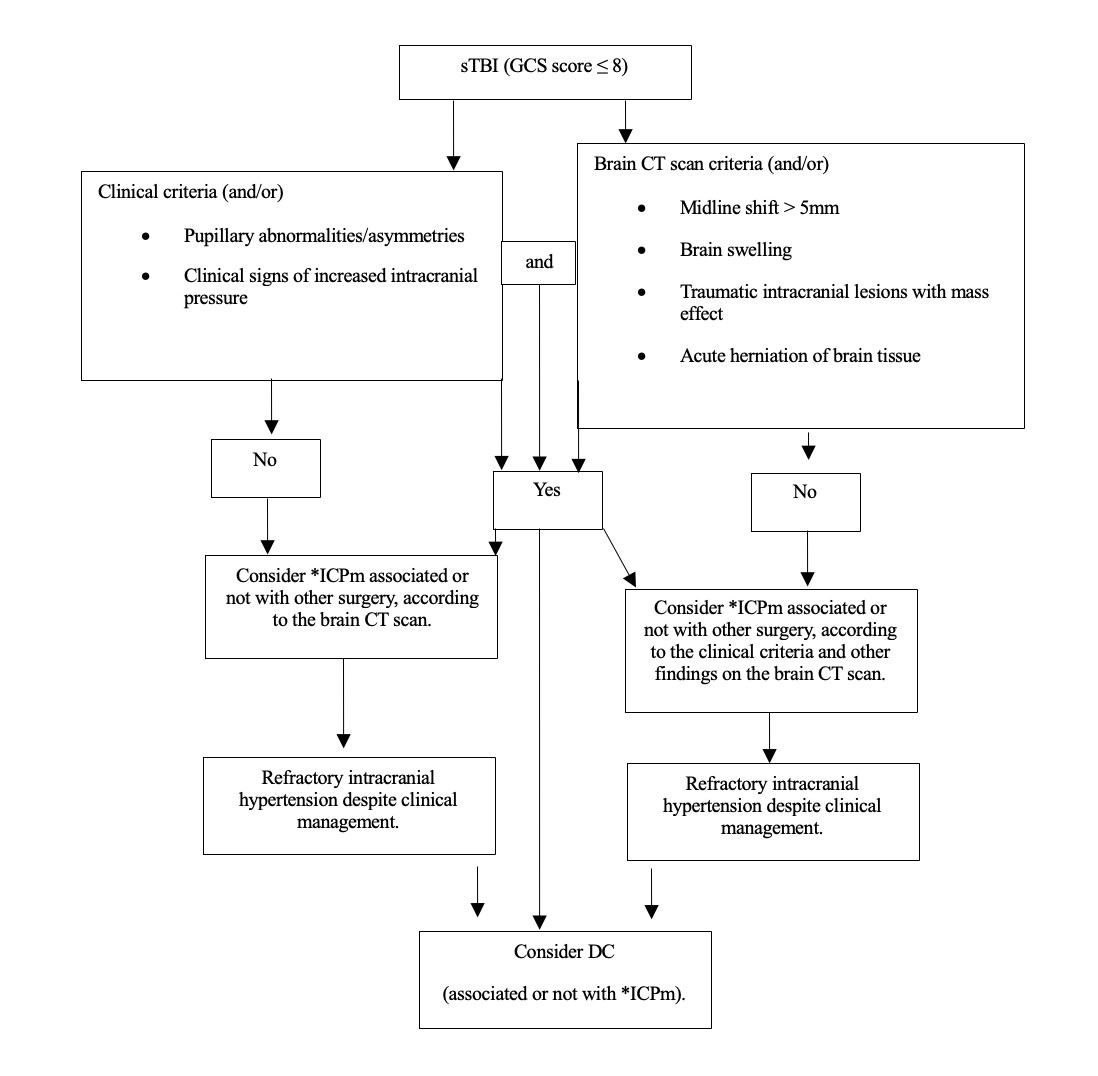
Introduction/Background: Decompressive craniectomy (DC) is a neurosurgical technique employed in pediatric patients with severe traumatic brain injury (sTBI). However, consensus remains lacking regarding the specific criteria for its indication. The objective of this study is to synthesize data concerning the clinical and CT scan criteria for performing DC in children and adolescents with sTBI.
Methodology: This systematic review analyzed scientific studies indexed in the MEDLINE database via the PubMed platform. The search included studies published between 2015 and 2025 that involved children and adolescents (under 18 years of age) with sTBI treated with DC. This review is registered in the International Prospective Register of Systematic Reviews (PROSPERO: CRD420251159406).
Results: Eighteen manuscripts describing the clinical and tomographic criteria for DC indication were included. In a combined sample of 916 children, pupillary abnormalities (162/343; 47.2%) were identified as a primary clinical factor guiding surgical decisions. CT imaging revealed post-traumatic intracranial mass lesions associated with midline shift (MLS), further justifying the procedure. Invasive intracranial pressure monitoring (ICPm) was utilized in 48.6% (386/794) of cases, and the overall mortality rate was 24% (220/916).
Conclusion: In children and adolescents victims of sTBI, pupillary abnormalities coupled with CT evidence of acute intracranial lesions, mass effect, and MLS are key indicators for DC, whether or not invasive ICPm is employed.
Downloads
Downloads
Published
How to Cite
Issue
Section
Categories
License
Copyright (c) 2026 Jose Roberto Tude Melo, Caio Vinicius de Almeida Chaves , Júlia Calviello Giordano , Luíza Malheiros Montagna , Henderson Rhavi de Jesus Luz , Paula de Almeida Azi , Jean Gonçalves de Oliveira , José Carlos Esteves Veiga

This work is licensed under a Creative Commons Attribution 4.0 International License.

When publishing in Archives of Pediatric Neurosurgery journal, authors retain the copyright of their article and agree to license their work using a Creative Commons Attribution 4.0 International Public License (CC BY 4.0), thereby accepting the terms and conditions of this license (https://creativecommons.org/licenses/by/4.0/legalcode).
The CC BY 4.0 license terms applies to both readers and the publisher and allows them to: share (copy and redistribute in any medium or format) and adapt (remix, transform, and build upon) the article for any purpose, even commercially, provided that appropriate credit is given to the authors and the journal in which the article was published.
Authors grant Archives of Pediatric Neurosurgery the right to first publish the article and identify itself as the original publisher. Under the terms of the CC BY 4.0 license, authors allow the journal to distribute the article in third party databases, as long as its original authors and citation details are identified.